
“The Alamo” of the stock market just fell.
This changes everything.
Are you standing at the walls of your brokerage account with nothing behind you? Or do you have a plan now that the gates have been breached?

Get in a time machine with me for a minute. (I can’t help myself, I’m a history nerd…)
The year was 1836. San Antonio, TX.
General Santa Anna’s army surrounded a crumbling Spanish mission on the edge of town.
Inside, 200 Texian defenders dug in. Outnumbered 10-to-1, low on supplies, and under no illusions about what was coming.
For thirteen days, they defended the Alamo.
On March 6, the Mexican army breached the walls before dawn. The battle lasted less than two hours. The walls fell.
Those men had nothing to protect them (or that precious mission) behind that line. No plan B.
As we speak, the walls of your account are being breached, just like the Alamo…
You need to defend it from the incoming siege. Or else.
How? I’ll give you a hint…
Why It’s Hedging Season
Back in December, I called $675-$678 “The Alamo” … the zone State Street SPDR S&P 500 ETF Trust (NYSEARCA: SPY) had to hold.
I said that if we broke below $675, you’d need to change your approach. To get defensive.
Well, we’re there.
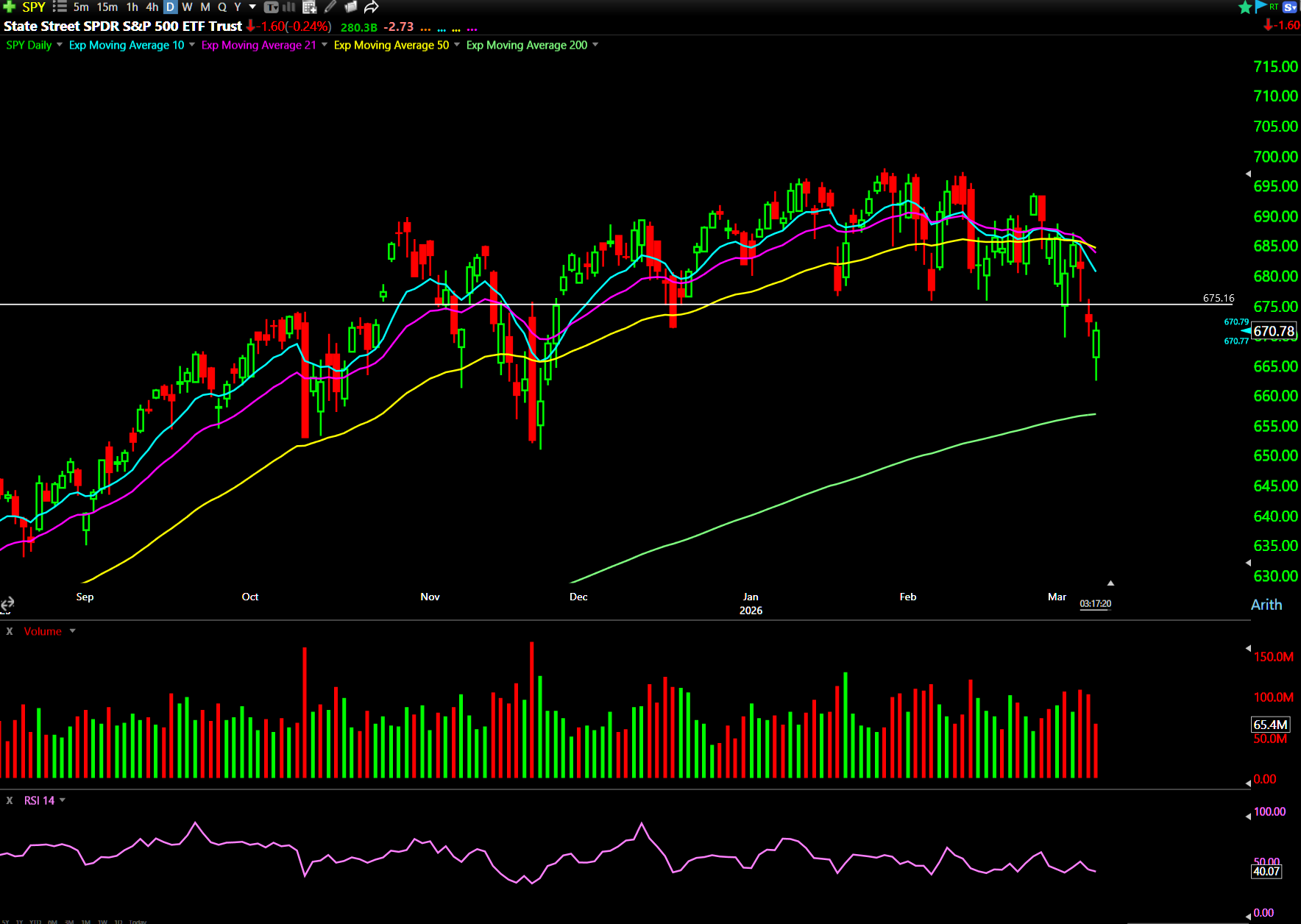
SPY closed Friday at $671, below the crystal-clear trading range it’s held (from $675 to $698) going all the way back to December.
There’s one final level of “last gasp” support…
SPY bounced off $669.70 on Tuesday, March 3, and again on Friday, March 6, creating a short-term double bottom (that’s held for now).
But “held for now” and “strong support” are two very different things.
If SPY breaks below that level, all bets are off…
Set a price alert at $669.70. Text, email, brokerage platform notifications. All of them.
Below $669, the next meaningful support lands at the 200-day EMA near $657, followed by price level support around $652.
Don’t panic. You can keep some call positions if they check every box.
But you need a hedge riding with them…
The 3 Steps to Hedging with Options
You’re probably wondering, “How do I hedge, Ben?”
The simplest way: through SPY puts.
Look at your hedge from 3 angles: size, strike, and expiration.
Size
Hedge 10-20% of your total call premium exposure
If you have $1,000 in calls, you’re putting $200 into puts. $5,000 in calls? $1,000 in puts. $10,000 in calls? $2,000 in puts. You don’t need to match your call exposure dollar for dollar … just enough protection to take the edge off a hard move lower.
Strike
Target somewhere between 5-7% out of the money on SPY.
That puts you in the SPY $630 to SPY $635 range right now. Those levels sit squarely in the typical market correction zone. Exactly where your hedge starts paying real money if the bottom falls out.
Expiration
30-45 days out is the sweet spot.
Short-dated options burn too much time decay (too quickly), and one week of sideways chop can wipe out the position. 30-45 day puts give you enough runway to survive volatility spikes, weather a few weeks of chop, and still be in the game when the move actually comes.
Something like a SPY April 11 $630 Put (roughly 35-40 days out).
If SPY drops from $671 to $650, those puts will be trading 3x higher (minimum).
I don’t always keep hedges on. When conditions are calm, they’re dead weight.
But with the VIX nearing 30, an active conflict in the Middle East, and a massive repricing of software stocks … we’re not looking at abstract, hypothetical risks.
And with so much uncertainty piling up at once, hedging isn’t a choice.
If your puts expire worthless, that’s simply the cost of doing business. It’s the price of keeping your calls from getting wiped out.
The defenders of the Alamo had no way to hedge.
You do.
Use it.
Happy hedging,
Ben Sturgill
*Past performance does not indicate future results