
It’s 9:30 A.M. Eastern, right after the market opens, and the stock on your screen is coiling before it spikes higher or falls lower.
One wrong step could blow up your account…
And the right one means mountains of cash.
It’s a minefield. And I’ve got a map to help you through.

Global catalysts are firing from every direction right now, and a single Truth Social post can undo a solid trade thesis in seconds.
It’s no wonder traders are unclear how to proceed.
I get it. The noise is deafening, and the volatility is confusing.
But the map I’ve used to navigate this minefield has always existed. You just have to know where to look.
I went live earlier this week and walked through my exact process for trading in this market. And I’m sharing it all with you here, step by step.
My Strategy Right Now
Here’s a screenshot from my livestream:
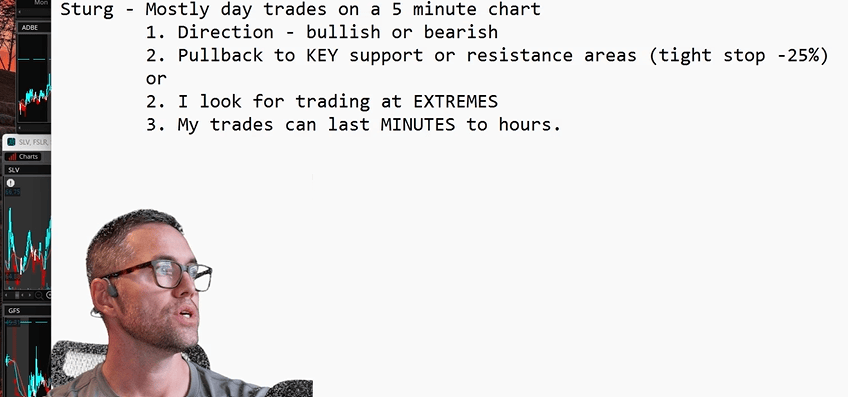
Let’s go through this list.
First of all, I’m mostly day trading with charts that show 5-minute candles.
Day trading helps lower my exposure to geopolitical catalysts. I’m in and out in a few minutes or hours.
The 5-minute candles ensure I’m not persuaded by outlier data.
Once my chart is set up, I’m looking for:
- The direction of the stock I want to trade.
- Key areas of support and resistance to find my entry.
On my initial trade, my stop loss is set to trigger if the position drops by 25% or more (that will change as my trade develops, keep reading).
Again, these trades can last a few minutes to a few hours. I’m not holding overnight. And I’m definitely not holding for multiple days.
Examples
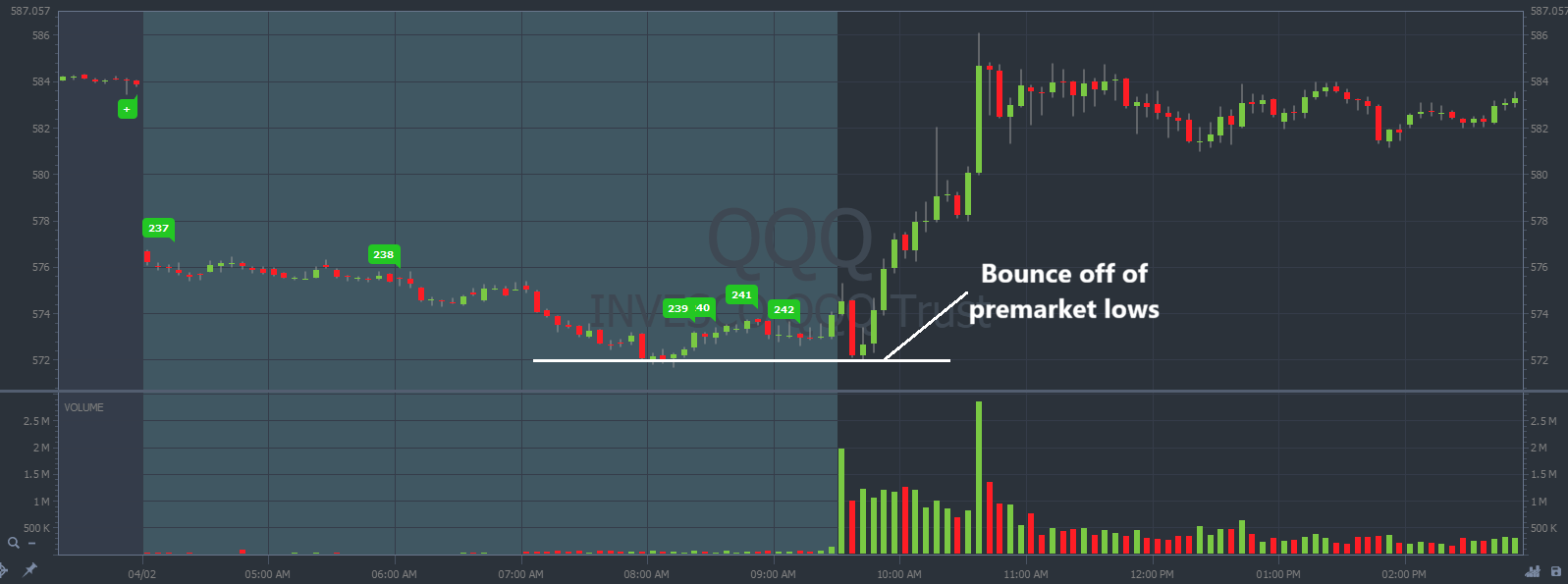
In my livestream, we were discussing the Invesco QQQ Trust (NASDAQ: QQQ)…
On April 2, the QQQ sold off during premarket hours, falling from $584 the day before to $572 per share.
When the market opened for regular hours, the QQQ didn’t break that level. It bounced off the premarket lows at support, and by mid-morning, it had recovered back above $580.
Then on April 6, the very next trading day, the same pattern showed up again.
The QQQ dipped to premarket lows near $586, directly after the open, tapped that level, and rallied.
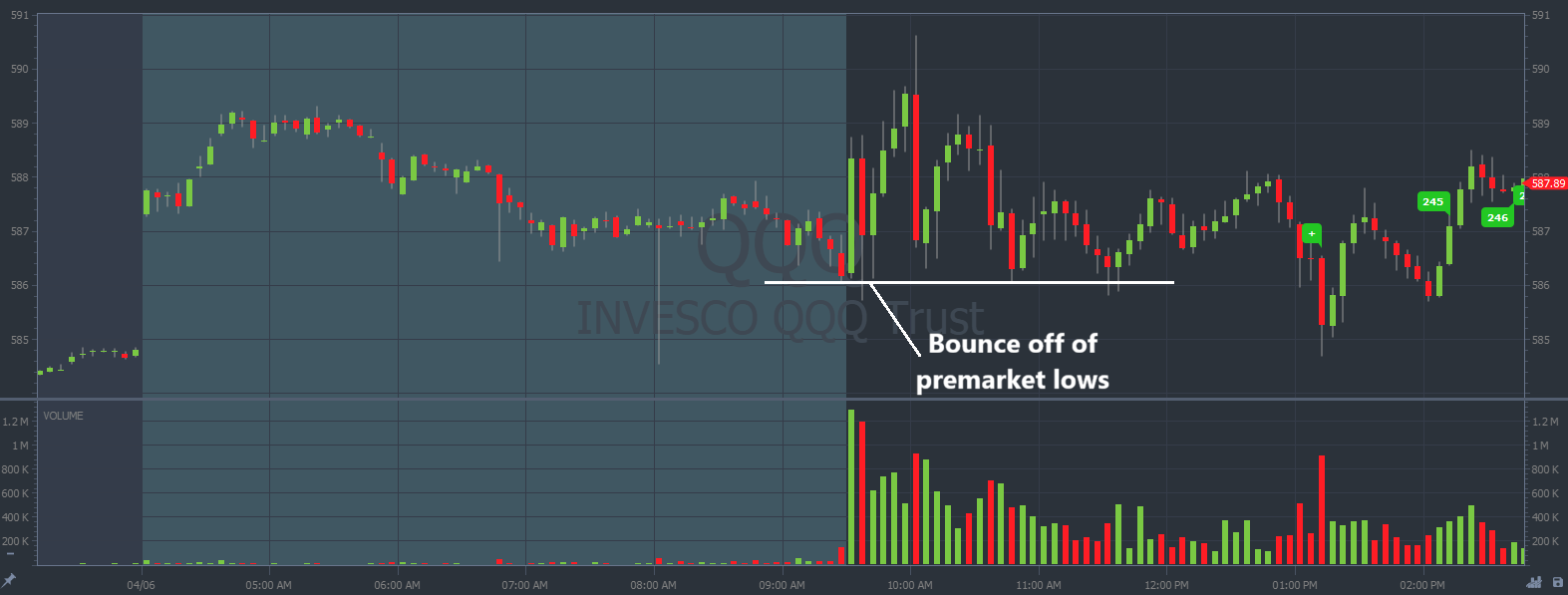
Two separate days with the same setup. Where premarket lows acted as support for a quick morning trade.
How To Manage the Trade
My initial stop loss sits around a 25% loss.
That’s a good level considering I stand to make 100%+ on some of these intraday options trades.
But once the play starts working in my favor and I take my first profit, the stop loss moves to break-even, or within $0.05 of break-even.
I don’t want to overstay my welcome. My winners could become losers… this strategy helps keep my account in the green.
There’s a common saying in the market: “Patient people take money from impatient people.”
At face value, it might look like I’m impatient…
- Quick trades.
- Taking quick gains.
- Moving up my stop loss.
This is a common misconception.
I’m trading patiently because I’m OK with a few percent gains here, and a break-even there… versus impatient traders who just want to buy and hold the biggest mover in the market until they become a millionaire.
I’m using a strategy, and they’re gambling.
Exercise patience. Use a tested strategy to trade these setups.
Be good (and be good to others),
Ben Sturgill
*Past performance does not indicate future results. Not typical.