

It might not be obvious to new traders… but almost every stock in the market follows the same framework.
It’s how I’ve managed to trade with the same patterns for years.
It happens over and over again…

Most new traders aren’t actually trading.
They’re gambling on hot stocks, half-baked theses, and random picks from social media.
And gamblers always get burned in the market.

When they could be trading a repeating pattern that we see on almost every stock.
Stop gambling. Start following this setup…
Every Stock Runs The Same Loop
Pull up almost any stock chart and you’ll find four repeating stages.
- Accumulation.
- Markup.
- Distribution.
- Markdown.
They cycle. One rolls into the next, then the whole loop starts over. And once you see it, you can’t unsee it.
Learn this framework once and you can reapply it on the next setup.
It’s like riding a bike.
In the primary stage, accumulation, the price stops falling and drifts sideways within a range, usually after a large drop.
There aren’t any lower lows. But there aren’t any higher highs either. It’s dull on the surface, and that dullness is the beginning of our trade.
This is where institutions quietly build their positions at cheap prices, while everyone else loses interest.
Stage two is the markup. Prices break the top of the range, the stock prints higher highs, and it often circles back to retest the breakout before it climbs again.
This is when retail traders finally notice and start buying the move, long after the big money has already loaded up.
Stage three is distribution. The higher highs stall. The price rolls sideways near the top. This is where institutions hand their shares to the folks chasing the move, the ones who got in late and buy on FOMO.
Stage four is the markdown. The range cracks to the downside, lower lows stack up, and the latecomers give up and sell to stop the pain.
Then the price finds a base, and stage one starts the loop again.
The Setup I’m Watching
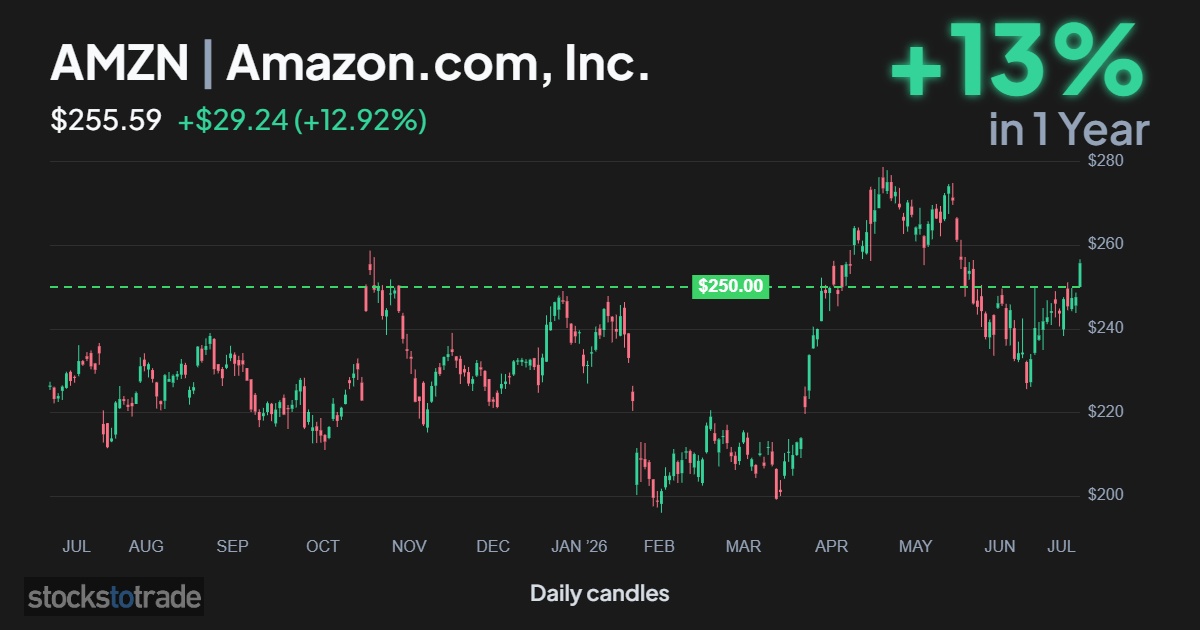
We’re seeing this framework play out on Amazon.com, Inc. (NASDAQ: AMZN) over and over again.
Rewind to the earnings drop on February 5, 2026 that dumped AMZN down near $200 per share. The company was pouring cash into AI data centers to clear a backed-up customer list. The spending that spooked the crowd handed a true gift to patient buyers.
I added to my long-term position down in the low $200s and thanked the market for the opportunity.
From that base, the price shot higher to make new all-time highs.
Since then, AI fears in the market caused a selloff to the low $220s.
The stock traded above the $220 level for a few weeks, unable to break above a key psychological level at $250 per share.
AMZN kept tapping the underside of $250 and getting rejected.
But this week, Smart Money traders started buying HUGE amounts of AMZN calls…
So I decided to take a stab. I bought AMZN JUL 17 $250 calls at $2.45 on Monday, July 13 (betting on a breakout).
And yesterday, it broke through $250.
I sold my final scale at $5.50 … a 124% gain in three days.*
The lesson is simple: When Smart Money bets line up with a strong chart, the odds are in your favor.
Wait For Price To Tell The Truth
This is the trap that snags new traders… they try to name the stage before the price action confirms it.
- You don’t know a range is stage one until prices break above it and hold.
- You don’t know a top is stage three until prices break below it and keep falling.
- A stage two that pauses looks identical to a stage three, right up until price picks a side.
That’s why we wait for the tell.
On AMZN, we had two tells. Smart Money volume and the break above $250. A risk-aware trade setup will wait for prices to retest that level, hold it, and rally again.
Our stop sits under the $250 support line.
- Two daily closes below $250, and you should step aside (the stock is likely heading lower).
- If the support holds, we ride toward that $280 target.
With earnings on the horizon, implied volatility tends to build into the report, which adds another tailwind to our backs.
If you traded the $250 breakout, you can take the gains and get out. Or you can wait for the retest and lower your risk.
Both are legitimate trade setups that follow our framework.
Look for the current stage of the price action. Wait for confirmation. And trade what the price shows you, not what you wish it would do.
Patient people take money from impatient people.
Learn the four stages, mark your levels, and let these setups come to you.
Be good (and be good to others),
Ben Sturgill
*Past performance does not indicate future results. Not typical.