
There’s nothing the market hates more than uncertainty.
And uncertainty is sky-high right now.
What’s so uncertain? Take your pick:
Conflict in the Middle East, unclear outcomes on the Supreme Court’s tariff ruling, net job losses in the economy, and/or a complete repricing of software stocks.
When stocks sell off as much as they have over the past few weeks, I bet I know what your first instinct is…
To buy the dip.
That’s what you’ve been trained to do for years. And can anyone blame you?
The vast majority of the time: Gaps get filled. Weakness gets absorbed. The market goes back up.
But sometimes, it’s more than a dip. It’s the start of a prolonged downturn.
This time? No one knows for sure.
But if you don’t know how to tell the difference, you’re at risk of getting crushed.
Last week’s selling pressure felt like a warning shot. And the market internals aren’t much better…
What now? Do you heed the warning and adjust your approach? Or do you ignore it and hope everything goes back to normal?
The market’s repricing risk across multiple fronts at once.
So, before you run out to buy every stock that’s down 10%…
Consider these five risks.
Risk #1: The War in Iran
Start with the Middle East. The U.S. and Israel launched coordinated strikes on Iran on February 28. The Iranian Supreme Leader was killed. Iran responded with over 500 ballistic missiles and nearly 2,000 drones.
We’re now on Day 10 of the conflict. 7 U.S. soldiers dead. Iran just named Mojtaba Khamenei (the son of the former Supreme Leader) as the new Supreme Leader.
The biggest immediate market effect has been on the energy sector…
Oil hit $120 a barrel before pulling back. Brent crude is trading around $106, up from $72 pre-conflict. Israel struck Iranian oil facilities in Tehran. Iran hit a Bahrain oil refinery. The Dubai airport was damaged, and flights were halted. 1,200+ Iranians reported dead.
This conflict is escalating.
Risk #2: The Tariff Ruling
The court struck down the executive tariffs 6-3, declaring them illegal. But the ruling created more questions than it answered.
Will the government return the collected tariff revenue to businesses? How will they calculate refunds? When will companies actually see the money?
Some estimates put total tariff collections over the past few years at $180 billion. If that money flows back to corporations, it’s a super-bullish, one-time boost to cash flows.
If it gets tied up in bureaucratic limbo for months or years, it’s dead capital. And the market may be pricing in refunds that won’t come for years.
On tariffs, uncertainty is the only certainty.
Risk #3: The Labor Market
The economy posted net job losses for the first time since the pandemic. Initial jobless claims ticked higher.
The narrative for the past two years has been “strong labor market supports consumer spending, supports corporate earnings.” If that foundation weakens, the entire thesis for stock prices starts to wobble.
Risk #4: The Software Repricing
And then there’s the software repricing. All it took was one demo from Anthopric’s Claude, and growth stocks that were trading at 40-50x forward earnings got re-rated down to 25-30x. Some names are down 20-30% from recent highs despite posting solid earnings.
The market is questioning how much AI infrastructure spending actually translates into revenue growth. It’s asking whether $115-135 billion in capex (Meta’s 2026 guidance) produces returns or just burns cash.
This is a fundamental reassessment of what investors are willing to pay for tech growth.
Risk #5: The VIX Uptrend
All of this is showing up in the VIX. The volatility index started 2026 around 14. It’s now hovering near 30. That’s 100% volatility gains in two months.
And to make matters worse, the uptrend is perfect (the least bullish uptrend in history).
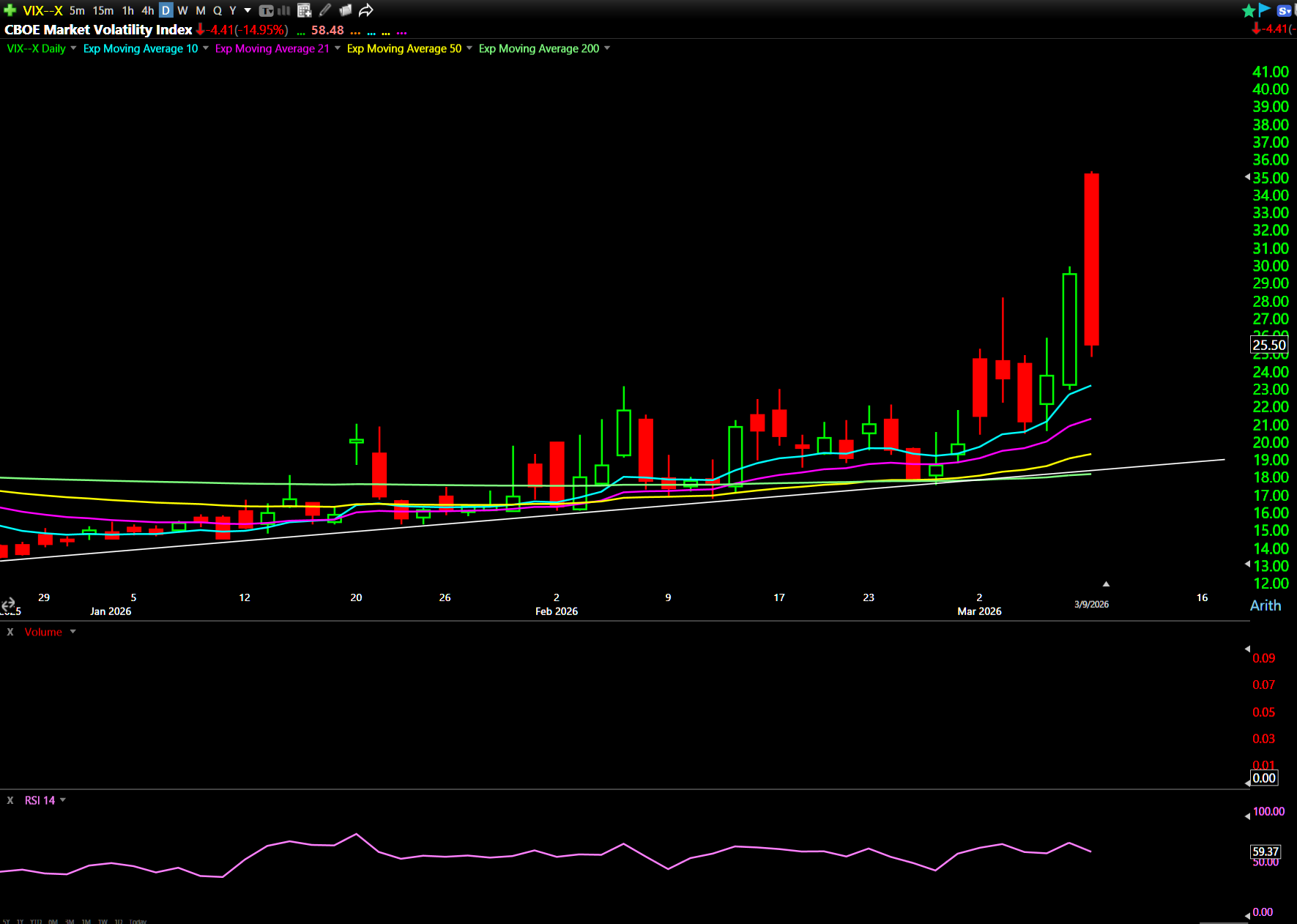
When the VIX is above 25, options premiums get more expensive. Bid-ask spreads widen. Intraday swings get violent.
So what?
Here’s what…
What This Means For Your Trading
There’s nothing wrong with NOT trading at all in a market like this.
Sitting in cash is a position. Watching from the sidelines while the VIX is spiking and geopolitical risks are stacking up is not a sign of weakness.
But if you do see setups that check every box, adjust your execution.
Use shorter holding times.
Unless it’s a hedge, don’t let positions sit for weeks. Take profits faster. Cut losses faster.
Trade smaller position sizes.
The math is simple: smaller size means smaller drawdowns when you’re wrong. And in a 20+ VIX environment, you’ll be wrong more often.
Focus on names showing relative strength in the weakness.
If the market is down 2% and a stock is flat (or up), that’s telling you something. That’s where Smart Money is hiding.
Those are the names that will lead when the market turns.
Be good (and be good to others),
Ben Sturgill
*Past performance does not indicate future results