
Our job as traders in the market: Buy low, sell high.
It’s four simple words. But for a lot of traders, it doesn’t seem very simple… until now.
How I buy low and sell high.

Everyone understands how to make money in the market. “Buy low, sell high, duh…”
But few are successful. And it comes down to a simple lack of understanding.
Lucky for you, I can clear up this misunderstanding in a single blog…
Price-Action Indicators
To buy low and sell high, we need to find stocks that are moving higher. Stocks that show us a bullish structure.
Here’s what I look for when trying to identify a directional structure on a stock:
- Bearish Structure: Lower lows, lower highs
- Bullish Structure: Higher highs, higher lows
On a stock chart, with all the different time frames, it’s easy to get confused about which portion of the price action is a “low” and which portion is a “high”.
Thankfully, we can use indicators to help us identify these structures without diving too deep into each chart.
- Bearish Structure: 8 EMA < 21 EMA < 34 EMA
- Bullish Structure: 8 EMA > 21 EMA > 34 EMA
I’m looking for when the 8 EMA crosses over the 21 EMA.
A Recent Example
Roundhill Memory ETF (CBOE: DRAM) is an ETF that primarily invests in “memory companies”.
That refers to technology-memory companies which store data for AI (it’s still a hot sector in 2026).
The ETF lost steam during the tech scare/earnings season earlier this year, making lower highs and lower lows. But on August 17 it made higher highs… and the momentum on the EMA’s confirmed it.
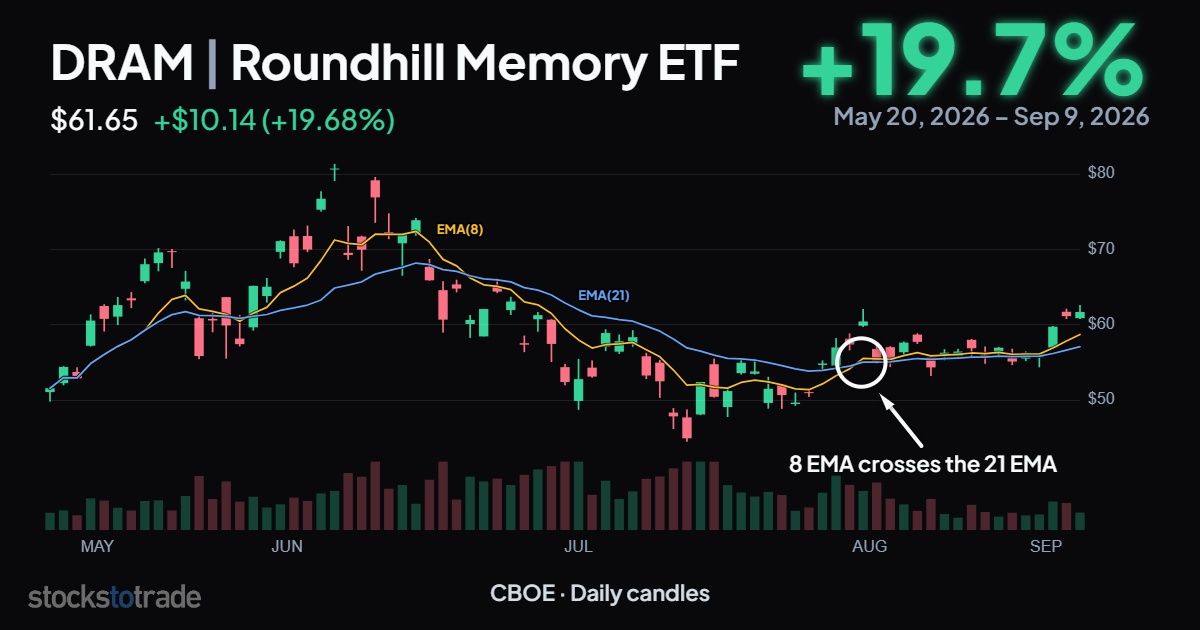
Notice, anyone who bought immediately when the EMAs flipped was stuck near the highs until the price rebounded a few weeks later.
Don’t buy at the highs.
Instead, use the 8 EMA crossing the 21 EMA as your indicator to plan a trade. Then wait for the price to find a support level and buy call contracts within the support zone.
On DRAM, the stock consolidated sideways for weeks above the previous highs from early August. That’s our entry. Then we sell into the strength that came in early September.
Build a scanner to find stocks that satisfy our EMA requirement.
And wait for the price to find support.

Be good (and be good to others),
Ben Sturgill
*Past performance does not indicate future results. Not typical.