

Good morning, traders…
One strictly-enforced rule has been the bane of small account traders for decades.
The Pattern Day Trader (PDT) Rule.
If you’ve got less than $25,000 in your brokerage account, you’re capped at three “round trips” (buy and sell of the same security) every five trading days.
Break that rule, and you’re locked out of day trading for 90 days (or until you deposit enough cash to hit that $25,000 threshold).
I’ve watched countless traders sit on their hands while perfect setups flash across their screens because they’ve already burned their three tickets for the week.
The opportunity is there. The rulebook says no.
But that might be changing soon…
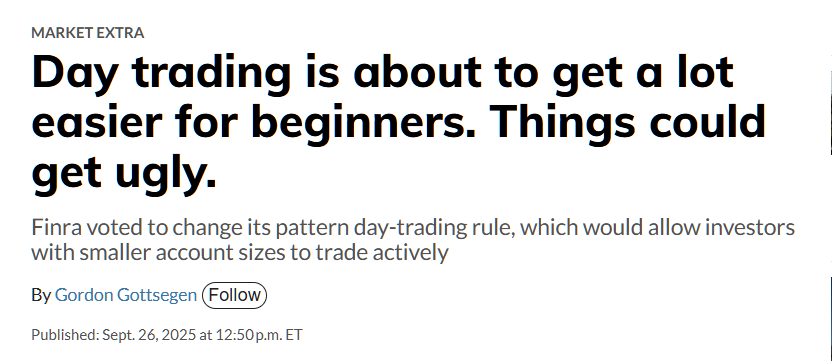
Last week, FINRA approved amendments that would replace the PDT rule.
If the SEC approves the changes, your small account will no longer need $25,000 to day trade.
Some traders are licking their chops. Others are nervous.
Both takes make sense.
Because removing this rule would open doors … but also remove guardrails.
Should The PDT Rule Get The Axe? Will It?
Let’s Break Down The Pros And Cons Of This Controversial Rule (And What Its Removal Could Mean For Your Trading)…
The Case for Removing the PDT Rule
In some ways, the PDT Rule punishes small accounts.
It was designed to protect retail traders from blowing themselves up with excessive leverage and impulsive trades.
But in practice, it handcuffs disciplined traders while doing little to stop reckless ones from finding ways to lose money.
If this rule gets axed, here’s what changes for the better:
Less Opportunity Cost
Right now, small accounts are limited to three “round trips” every five days.
That means you’ve gotta pick your spots carefully, which sounds smart…
Until you realize you might be passing on setups that meet your criteria simply because you’ve already used your trades for the week.
Removing the rule means you can trade every setup that qualifies, not just the ones that fit your arbitrary weekly limit.
Tighter Stops Without The Penalty
This one’s huge. Small account traders often avoid tight stop-losses because they don’t want to “waste” a day trade on a position that gets stopped out early.
So they widen their stops, take on more risk per trade, and end up losing more money when they’re wrong.
Without the PDT rule, you can set stops at the level that invalidates your thesis without worrying about burning through your limited trades.
That’s better risk management, plain and simple.
Freedom To Exit When You’re Wrong
Let’s say you enter a trade, and within 15 minutes, you realize you misread the setup.
With the PDT rule, exiting early burns a day trade. This forces some traders to hold longer than they should, hoping the position turns around.
That’s backward. Removing the rule means you can cut losers fast without a penalty, which is what you’re supposed to do.
These are real advantages. Traders with smaller accounts would finally have the flexibility that larger accounts have always enjoyed.
But flexibility cuts both ways…
The Dangers of Removing the Rule
Here’s the uncomfortable truth: restrictions breed discipline.
The three-trade limit forces you to be selective. You can’t take every setup that looks halfway decent.
You’ve gotta choose your battles. And for traders who are still learning, that forced selectivity is a virtue, not a curse.
Remove the rule, and here’s what I’m worried about:
Overtrading Becomes The Norm
The PDT rule acts as a speed governor. You can only go so fast before the system stops you.
Take that governor off, and some people will overtrade just because they can.
I’ve seen this happen with traders who finally cross the $25k threshold. The first thing they do is start taking more trades.
Not better trades. Just more. And their P&L suffers.
It Could Incentivize Scalping (Which Destroys Options Accounts)
This one scares me. Remove the PDT rule, and some traders will convince themselves they can scalp options.
They’ll jump in and out multiple times per day, chasing $0.10 and $0.20 moves on contracts.
But some options have wide bid-ask spreads. You’re paying $0.05 to $0.15 in slippage on every entry and exit.
Do that five times in a session, and you’ve handed over $0.50 to $1.50 per contract in friction costs alone — before commissions.
You need the underlying to move significantly just to break even. Scalping works for stocks with tight spreads and high liquidity. It’s a death sentence for options traders with small accounts.
New Traders Won’t Learn Position Sizing
Part of surviving as a small account trader is learning how to size positions properly so you don’t blow up on a bad day.
The PDT rule forces you to think about the big picture.
You can’t just jump in and out willy-nilly. You’ve gotta plan your trades.
Remove that constraint, and I worry that new traders will develop bad habits, like chasing every move, sizing inconsistently, or treating their account like a slot machine (rather than a business).
What This Means For You
If the PDT rule disappears, it won’t make you a better trader.
It’ll give you more freedom. But freedom without discipline is chaos.
The traders who’ll benefit most are the ones with sub-$25,000 accounts who already trade with a plan.
They already trade carefully. They track their stats. They don’t need the rulebook to tell them when to stop.
If that’s you, removing the PDT rule is pure upside.
The traders who’ll struggle are the ones who don’t have a process yet. The ones who are still figuring out what works. The ones who mistake trading often for trading well.
So here’s my take: if you’re under $25k and you’re hoping this rule gets removed, ask yourself one question first.
If the restriction disappeared tomorrow, how would it change your approach? Would you take more trades because you can set tighter stops? Or would you take more trades because you can?
Be honest. Because the market doesn’t care about your reasons. It only cares about your execution.
And speaking of execution…
Want to see exactly how I find (and manage) my trades?
The same system that’s delivered gains of 135%, 161%, and even 409% … just in September alone?*
Join the great Danny Phee TOMORROW, October 3 @ 4:00 p.m. EST for a LIVE OMEN WORKSHOP.
Happy trading,
Ben Sturgill
*Past performance does not indicate future results