For the past three months, the market has been stuck.
Up a little. Down a little. Seemingly going nowhere.
Don’t fall for the chop. I have a system to protect my account.

During my live session, I asked traders a simple question: When you look at this market, what’s your hope?
One answer summed up what everyone was feeling…
“I want it to stop chopping and get going, one way or the other.”
I want that too.
On October 6, the S&P 500 ETF Trust (NYSE: SPY) gave me a glimpse of exactly what I’d been waiting for.
- New highs.
- A clean pullback.
- A perfect bounce.
Everything was lining up…
But if I’d traded what I was hoping for, I would have been caught in the drop that followed.
This is a trap that almost every trader falls for at some point.
It doesn’t show up on your chart. It shows up in your head. And it can convince you that something specific will happen, but it never does.
Today, I’ll show you how I avoid it.
There’s one thing I demand from every setup before I put money on the line, and a simple rule that keeps me from turning trading into gambling.
The SPY Setup
Let’s go back to that October 6 price action.
The SPY made new highs. Then it pulled back and retested the 8-day EMA. Then it bounced.
That’s exactly what I wanted to see. But it wasn’t enough.
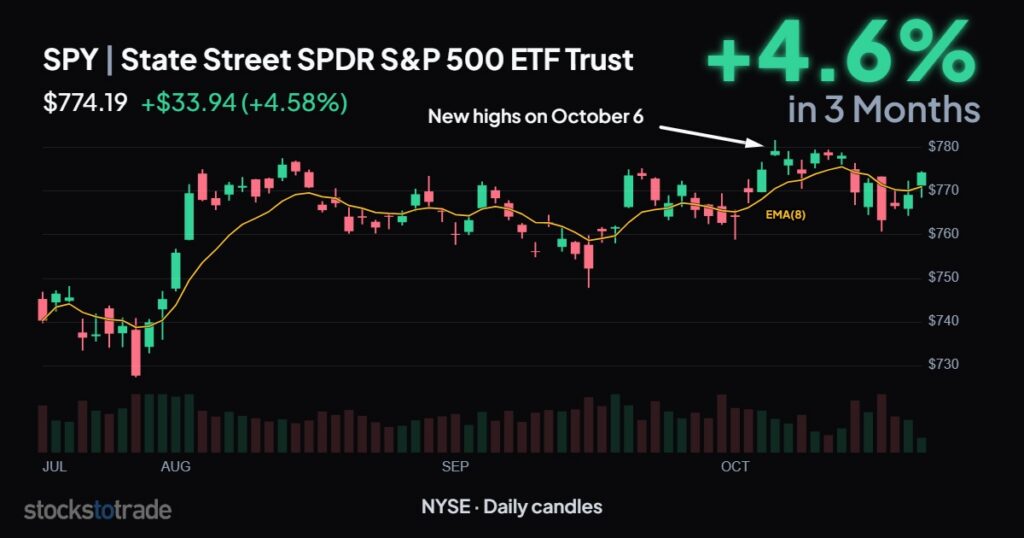
To confirm the SPY was in a trend, I needed one more thing: a higher high.
But the SPY denied the uptrend. So what kind of market do we have?
Consolidation.
The SPY is moving in roughly a 3% range. It’s not breaking down, but it’s not pushing higher either.
Here’s why that matters…
A trending market gives us follow-through. A consolidating market doesn’t. And if I don’t have follow-through, I don’t have an edge.
But I really hoped it would break out.
When we hope for something, we’re admitting we have no control over the outcome. We can’t make the SPY break out. We can only wait and see.
But when we want something badly enough, our brain starts looking for proof.
The moment we see it might be happening, we convince ourselves that it’s true.
We see what we want, not what is.
That’s how traders jump in before the confirmation… and get caught in the drop that follows.
If I trade on the hope that a stock will break out, without an edge, I’m not trading.
I’m gambling.
Hope, But Confirm
During the Cold War, when the Soviets said they would disarm, Ronald Reagan answered with three words: “Trust, but verify.”
In trading, I have my own version…
Hope, but confirm.
There’s nothing wrong with hoping. I hope every trade that I take works. I hope the market breaks out. But hope can’t be my reason for entering a trade.
Here’s the process I follow:
- Know what you’re hoping for. Say it out loud. Write it down. If you don’t know what you’re hoping for, you won’t notice when it starts clouding your judgment.
- Decide what must happen to confirm it. For the SPY, it was a higher high. Set the bar before the move, not during it.
- Don’t act until the chart proves it. If the confirmation doesn’t come, the setup didn’t happen, no matter how close it looks.
The difference between gambling and trading: Gambling is driven by emotional desire. Trading should be driven by intellectual conviction.
In this market, I’m being very selective. The SPY is consolidating, so I’m not forcing trades.
The market will do whatever it wants to do. My job isn’t to predict. It’s to respond to what’s actually on the chart.
Trade the market you have, not the market you want.
Be good (and be good to others),
Ben Sturgill
*Past performance does not indicate future results. Not typical.