My day trading system is built on simplicity.
1 ticker. 1 timeframe. 1 indicator. 1 strategy. 1 day.
It teaches you to open your charts and identify the setup right away.
You learn to create a risk management plan. You learn to execute that plan. You learn to trust yourself to execute without hesitation.
You take the trade, or you don’t, and you move on.
Yesterday was a perfect example of why this system works.
I made a ridiculously simple day trade for 100% gains in just a few hours.*
(And I only caught part of the move…)
Bottom to top, these contracts gained over 500% yesterday.
Let me show you how I found this setup…
Setup #1
Before I got to my 100% win, I looked at multiple names that seemed like contenders early on…
Carnival Corporation & plc (NYSE: CCL), Hut 8 Corp. (NASDAQ: HUT), and United Airlines Holdings Inc. (NASDAQ: UAL) all came across my scanner, but didn’t check all my boxes.
Pass, pass, pass.
The next name that made sense was Occidental Petroleum Corporation (NYSE: OXY).
OXY April 24 $58 calls.
Entry: $57.85 stock price.
Target: $58.80 to $58.85 stock price.
Stop: $57.50 stock price.
That’s about $1.00 upside and $0.35 downside. 3:1 risk-reward ratio.
Good ratio, but weak open, selling pressure early, and no clear reclaim of VWAP.
Pass.
Setup #2
Eli Lilly and Company (NYSE: LLY) was a strong name, but a completely different setup.
LLY April 10 $980 calls.
Entry: $950 stock price.
Target: $973 stock price.
Stop: $947 stock price.
This was a high-of-day breakout. Momentum continuation. Psychological level play at $950.
But LLY is an expensive stock (around $960). Larger option premiums. Faster moves in both directions. Less forgiving.
I passed on every one of those setups. And I’m glad I did…
Knowing what not to trade is just as important as knowing which stocks to enter.
Opportunity cost can ruin your day by locking you in a breakeven trade (or small loser) when you could’ve been trading a massive winner.
You might’ve felt an urge to trade yesterday, just because the market gapped up…
But you should only trade when all your criteria appear simultaneously.
Like this…
The 100% Setup
After sorting through OXY, LLY, and others, I opened a chart that practically screamed in my face:
Intel Corporation (NASDAQ: INTC).
This stock has been an absolute beast. Already up more than 30% in a little over a week.
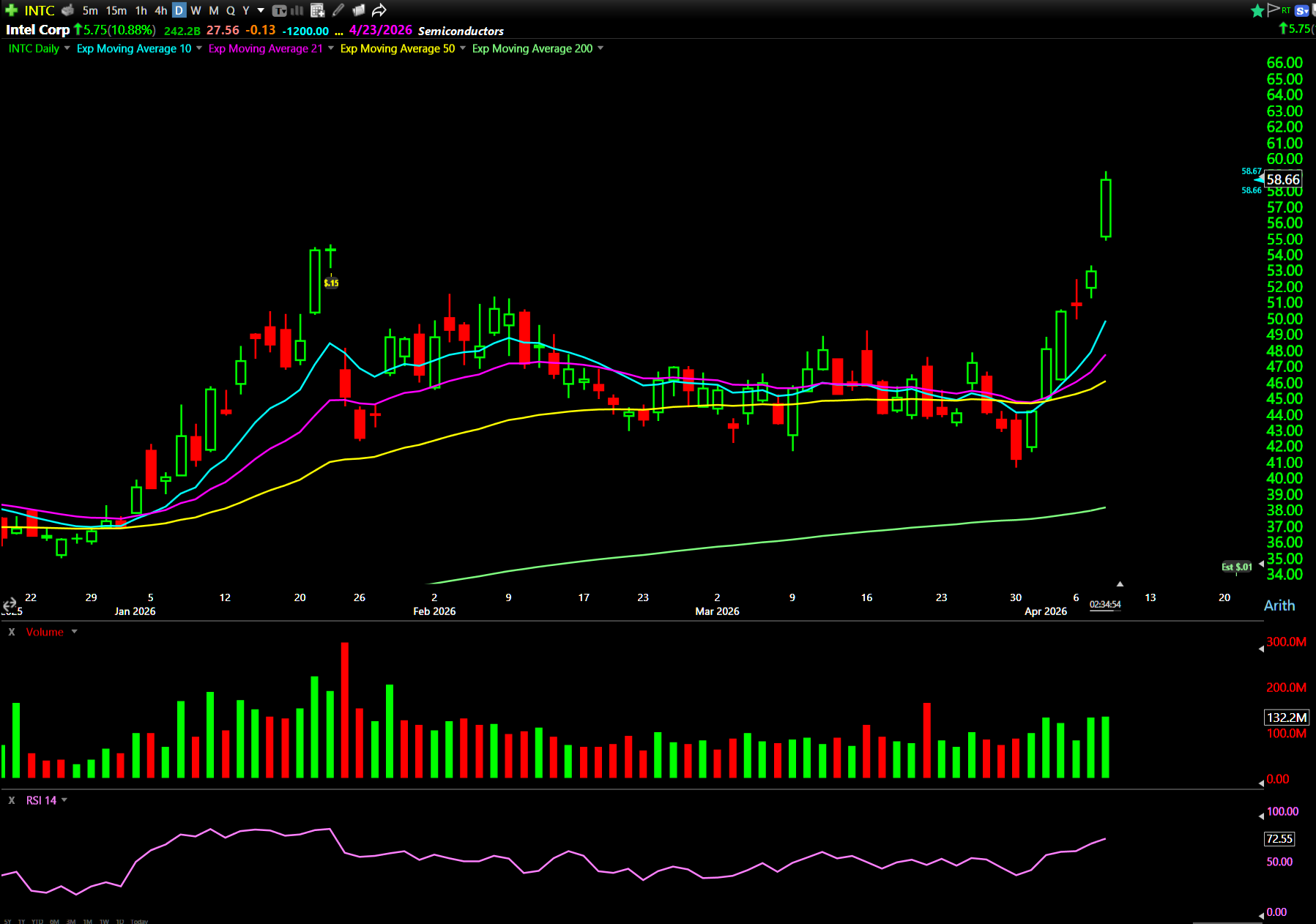
But I thought it could go further because it had:
- Trend (overnight strength) increases continuation odds.
- Morning strength confirms buyers are active.
- VWAP pullback gives you controlled risk and a better entry.
- Scanner confirmation showing Smart Money buying pressure.
When all four line up, that’s an A+ setup.
This is what I mean when I talk about “stacking probability.”
How I Traded It
Smart Money volume was on the INTC April 10 $57 calls.
So I wrote out a plan:
Entry: $56.65 stock price, $1.30 options premium.
Target: $57.75 stock price, $1.85 options premium.
Stop: $56.15 stock price, $1.05 options premium.
That’s roughly $0.55 upside and $0.25 downside. 2:1 risk-reward ratio.
That’s the entire playbook. Nothing fancy. Clean as a whistle.
The chart immediately started moving up, eventually gaining as much as 7% intraday:
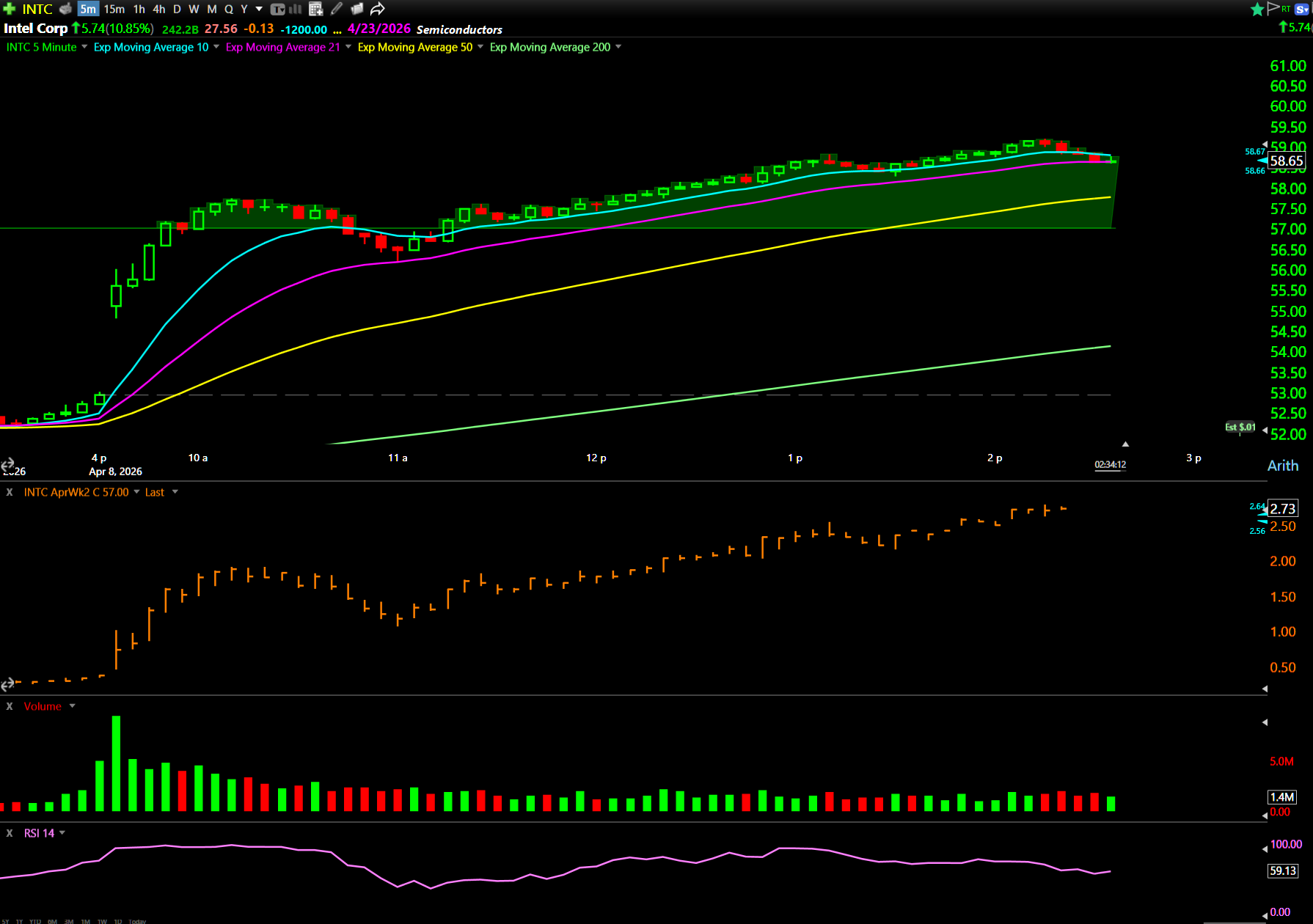
I scaled out three times exactly according to my plan:
Entry: $1.32
Scale 1: $1.58
Scale 2: $1.85
Scale 3: $2.30
Final Scale: $2.65
It doesn’t get much better than that.
Ask This Question Every Morning
You need to start asking yourself:
“Out of all the setups I’m seeing today, how do they rank?”
My rankings from yesterday:
- INTC. Best setup. Trend plus strength plus VWAP plus scanner. Highest probability.
- OXY. Scanner plus sector strength, but a weaker chart structure. Medium probability.
- LLY. Strong trend. No pullback structure. Expensive. Lowest probability of the three.
You don’t trade everything. You wait for alignment.
You want trend, strength, pattern, and confirmation.
When those stack, you don’t hesitate.
That’s how I made 100% intraday on INTC.*
And that’s how you can make similar moves tomorrow.
Be good (and be good to others),
Ben Sturgill
*Past performance does not indicate future results