Good morning, traders…
Something strange is happening in the bond market…
Last week, we saw one of the sharpest Treasury selloffs in recent memory.
Yields on the 10-year U.S. Treasury shot up by 17 basis points in a single day to 4.5% — one of the biggest daily swings in two decades.
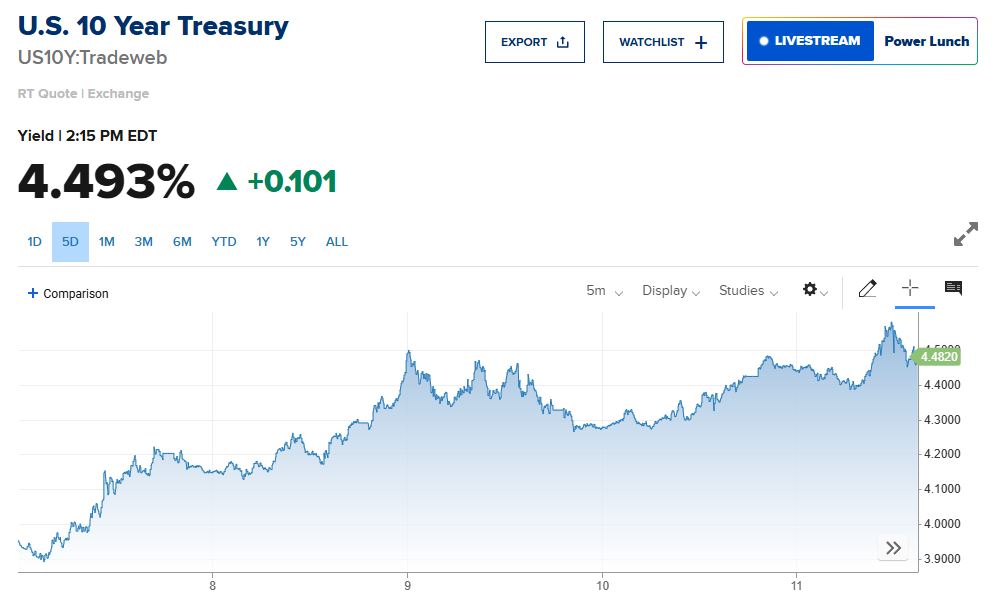
Then, on Friday, mortgage interest rates surged 13 basis points to over 7% — their highest levels since February.
Normally, Treasuries are the safety net during market stress. They’re inversely correlated to the stock market. Yields go up, stocks go down … usually.
But this time, investors started dumping Treasuries at the same time as stocks, echoing the panic selling we saw back in early 2020 when COVID fears locked up the system.
So, what’s causing this counterintuitive move? A mix of things:
- Hedge funds are getting hit across the board and forced to sell to meet margin calls.
- The unwinding of complicated trades that were heavily leveraged.
- Concerns that Trump’s trade policy could stoke inflation and limit the Fed’s ability to cut rates.
Put simply, the bond market is showing signs of serious weakness. And when the most liquid market in the world starts to wobble, everything else — stocks, credit, currencies — can follow along.
If you don’t understand bonds at all yet, that’s okay. You don’t need a PhD in macroeconomics to be a great options trader.
But right now, as we face this historic bond volatility, it’s important to understand the basics of how they work…
The Basics of Treasuries and Yields
A U.S. Treasury is a debt instrument issued by the U.S. Department of the Treasury to raise money for the federal government.
In other words, it’s a way for the U.S. government to borrow money.
When you buy a U.S. Treasury, you’re lending money to the U.S. government. In return, they agree to pay you interest — and then repay the full amount at a set date in the future.
There are a few main types of Treasuries:
- Treasury bills (T-bills): Short-term (mature in one year or less). Sold at a discount — you pay less than face value and get the full amount back at maturity.
- Treasury notes (T-notes): Medium-term (2 to 10 years). Pay interest every six months.
- Treasury bonds (T-bonds): Long-term (20 to 30 years). Also pay interest twice a year.
- TIPS (Treasury Inflation-Protected Securities): Bonds that adjust with inflation, so your return keeps up with rising prices.
Treasuries are considered the safest investments in the world because they’re backed by the full faith and credit of the U.S. government.
That’s why big institutions and foreign governments buy them — not just for returns, but for security.
A bond yield is the return you get for holding a bond.
Say you buy a 10-year U.S. Treasury bond for $1,000, and it pays $30 a year in interest. Your yield is:
$30 / $1,000 = 3%
Now here’s where it gets interesting — and where most people start to tune out:
Bond prices and bond yields move in opposite directions.
Let’s say that same bond drops in price because the market is selling off. Maybe it falls to $900, but it still pays $30 in interest. That means your new yield looks like this:
$30 / $900 = 3.33%
So the bond got cheaper, but the return went up.
That’s how yields rise: the price drops, but the fixed interest stays the same.
Why This Matters Now
This is exactly what’s happening right now…
Investors have been selling Treasuries — either because they’re nervous, trying to raise cash, or being forced out of positions.
That wave of selling pushes bond prices down and yields up. When you hear “yields are spiking,” this is what it means.
The technical term might be “margin call selling,” “swap spread tightening,” or “basis trade unwinding,” but at the core, it’s just supply and demand.
Fewer buyers + more sellers = lower prices = higher yields.
And with Treasuries, that math matters a lot.
When the U.S. government issues Treasuries, it’s borrowing money. If demand for those bonds drops, the government has to offer a better deal to attract buyers — which usually means lower prices and higher yields.
The Ripple Effects of Higher Yields
Higher Treasury yields aren’t just a bond market story — they raise the cost of borrowing across the entire economy.
- Mortgage rates go up.
- Corporate debt becomes more expensive.
- Growth stocks can take a hit because their future earnings get discounted more heavily.
In short, rising yields are a signal that economic pressure is building. And if yields move fast, like they did this week, that pressure can lead to pretty bad outcomes in the stock market … quickly.
But mid-week, we got a surprising turn in the bond rout…
A Twist in the Bond Story + A Pause on Tariffs
On Wednesday, the U.S. Treasury auctioned off $39 billion in 10-year notes.
Despite the broader selloff, demand was surprisingly strong. The yield came in 3 basis points below expectations — tied for the second-best trade-through on record.
That’s a signal that, even in a bruising market, there’s still appetite for Treasuries … just maybe not at any price.
If you’re confused by all of this back-and-forth in the bond market, you’re not alone.
No one has completed this bond puzzle yet. We’re still sorting through what all of this means for the markets.
But the important thing is: you need to be watching Treasury yields.
If you see them making big moves — especially when the stock market is closed — use those moves to inform your trading.
Happy trading,
Ben Sturgill
P.S. I’ve been using a brand-new tool … and it’s completely changed how I trade.
I’m talking about a proprietary indicator with the potential to deliver outsized gains that even my Omen Scanner won’t catch…
(And I’m even giving away a FREE TRADE IDEA using this tool that could surge over the next seven days.)
Click here to see my FINAL WARNING … before it’s too late.
*Past performance does not indicate future results