Good morning, traders…
Freedom is the greatest part of trading.
I make my own schedule. I only trade when I want to.
Or, that’s what I tell myself.
But you know how it goes…
Those charts can be downright hypnotic…
Green and red candles reflecting in your eyeballs, price action luring you in like a mystery novel, trade possibilities crossing your mind faster than you can rank them…
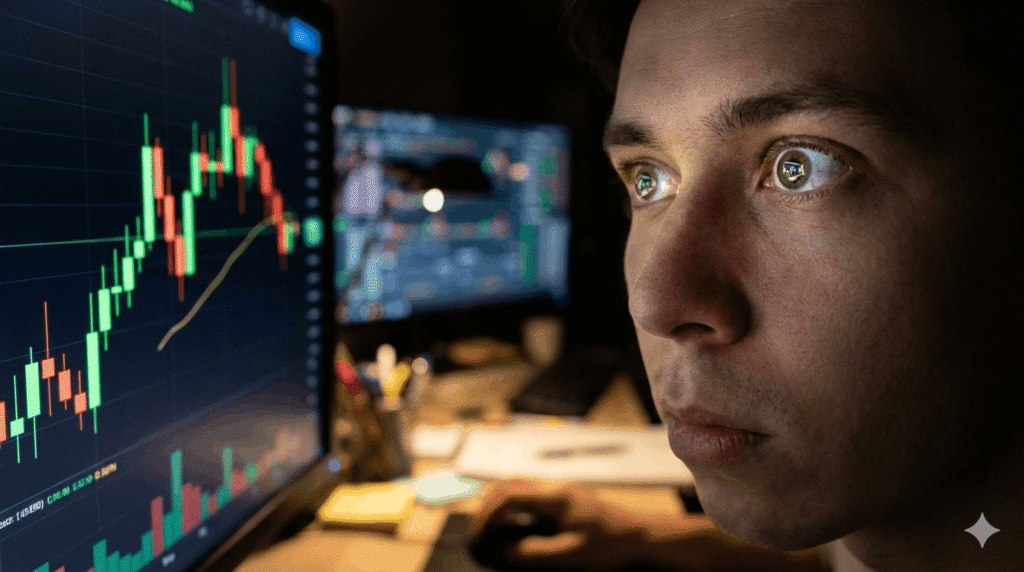
There was one day last month when I sat at my desk from 6:30 AM to 3:45 PM, glued to my screens…
My back ached, my eyes burned…
But I didn’t actually do anything.
By the closing bell, I had executed exactly zero trades.
Let’s be clear: There’s nothing wrong with that.
(In fact, trading every day might be hurting you.)
But missing triple-digit winners because your mind is pulled in dozens of different directions?
Totally counterproductive.
You don’t need to monitor your positions constantly, or stare at six monitors all day…
There’s a much easier way to trade…
The Hidden Cost of Screen Time
All those hours of screen time cost you in ways you don’t realize.
By hour six, your brain turns to mush, but you keep watching, wasting time looking at 25 charts at once…
What do you get out of that?
This is a recipe for burnout.
All while you could be living your life, just waiting for a quick buzz on your phone…
How Price Alerts Made Me 122% Overnight
On February 3, I wanted to buy Apple Inc. (NASDAQ: AAPL) calls at $269.
Why $269? It was the premarket high of that day.
Premarket highs often act as support on pullbacks because that’s where institutional buyers stepped in before the regular session.
I set an alert at $259.90, closed the chart, and played some basketball with my boys.
When AAPL hit $259.90, my phone buzzed.
I evaluated the setup with fresh eyes.
Huge volume? Smart Money confirming? Pattern holding?
I executed.
That trade returned 122% in less than 24 hours.*
And I didn’t have to stare at the chart all day…
Price alerts were my secret weapon.
My 4-Step Alert Framework
Here’s what I do:
Step 1: Identify key levels: Support zones, resistance levels, pullback zones, breakout areas. Not every price is important. But some are absolutely critical.
Step 2: Set alerts strategically: Slightly above breakout levels or below breakdown points. This catches momentum early without whipsaws.
Step 3: Evaluate when triggered: Alert fires, I check the chart. Does it meet my criteria? Is Smart Money confirming? Volume supporting?
Step 4: Execute or pass: If everything aligns, make the trade. If not, wait for the next alert.
Removing yourself from constant price action changes your trading psychology.
You avoid the “sunk cost” mentality…
“I’ve watched this for three hours, I HAVE to trade.”
That’s justifying wasted time, not trading through discipline, rules, and process.
Space exists between trigger and action.
When alerts fire, you can completely delete your emotions.
You have your plan beforehand. Then you execute.
How To Build Your Own Alert System
Start with 5-10 quality setups from your watchlist. Contracts that have Smart Money volume on charts with high-probability patterns.
For each, identify the 1-2 price levels that would change your outlook. Breakout above resistance, breakdown below support (levels that signal meaningful shifts).
Set alerts in your brokerage platform.
It should be able to send you emails, desktop notifications, and/or text messages.
Then trust the system and walk away.
Try this for one week.
I bet you’ll find trading more straightforward, less emotional, and far less time-consuming.
Be good (and be good to others),
Ben Sturgill
*Past performance does not indicate future results