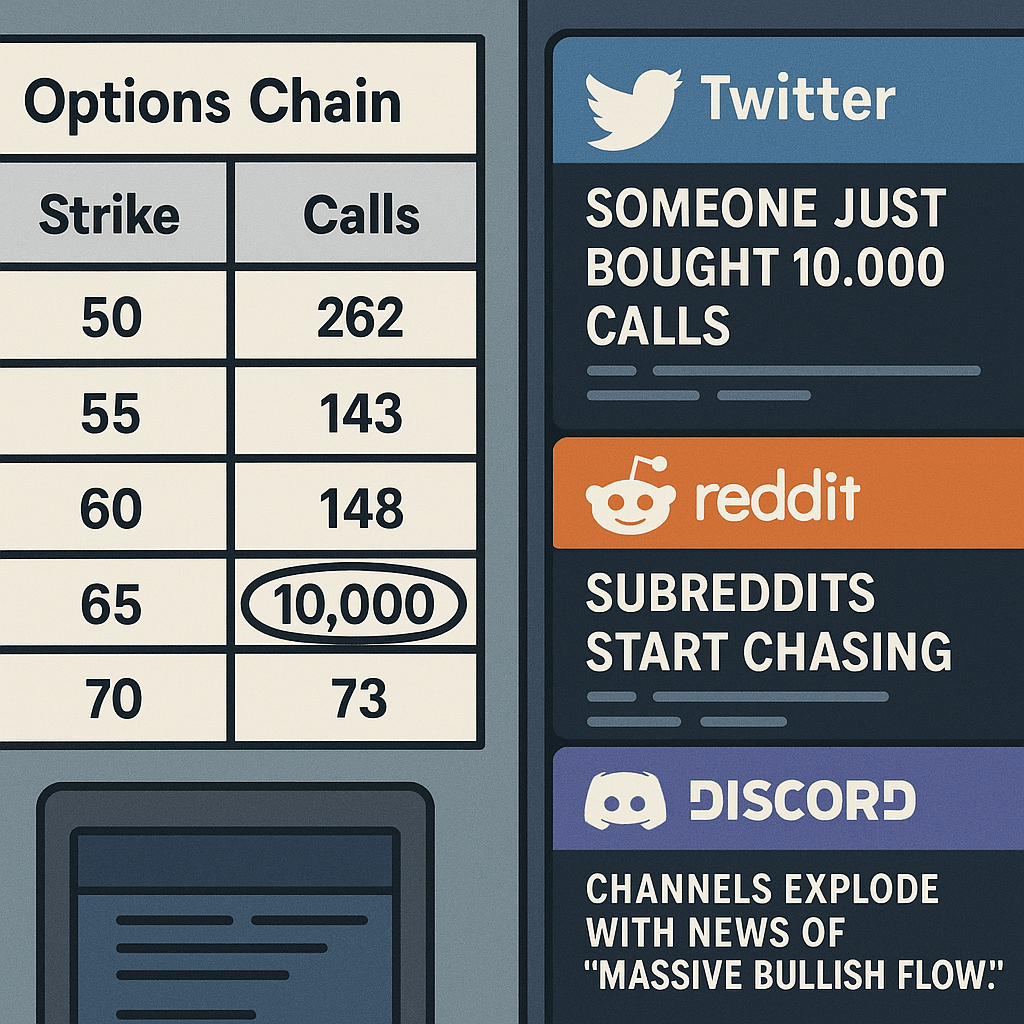
Let’s say you open an options chain and notice someone just bought 10,000 calls.
Twitter, subreddits, and Discord channels explode with news of MASSIVE BULLISH FLOW.
What’s your first instinct?
You’re probably scrambling to figure out what the mystery trader knows…
Is there a buyout coming? Earnings leak? Inside information?
You don’t know, but you buy calls.
You’re following the Smart Money, right? You’re doing what I do, right?
Not exactly…
The stock drops 10% the next day. Your calls lose 95% overnight.
What happened? You got fooled by a hedge.
But wait.
Calls are bullish, right? Not always…
If an institution is short a stock, it might buy calls to protect itself from big upside moves in that stock.
If the stock rips higher, those calls offset their losses on the short position.
What looks like bullish flow to you may actually be an institution protecting a short.
That’s the opposite of bullish.
Yet there you are, holding your calls, thinking you were following Smart Money into a directional play…
When in reality, you were following someone buying insurance against a short position you didn’t even know existed.
Unusual options activity can be one of the most valuable tools in your arsenal … if you know how to read it (and use the right tools)…
But seeing big call volume and assuming it’s “bullish” is a recipe for disaster.
Why I Track Unusual Options Activity
When someone places a trade much larger than what the options chain normally sees, that’s unusual activity.
Like buying 5,000 call contracts on a stock that usually sees 200 contracts per day.
It stands out. And it gets flagged by scanners that track order flow.
The assumption is that someone with a lot of money knows something you don’t. And if you can follow their lead, you can profit from the same information.
Sometimes that’s true. Institutional traders, hedge funds, and insiders do make directional bets that show up as unusual activity.
That’s what my entire Smart Money trading strategy is built around.
But institutions also use options to hedge their long-term positions, manage risk, and neutralize exposure.
And if you aren’t using the right tools, those trades look identical to directional bets when they appear on an options chain…
The Hedging Trap
Let’s say a hedge fund owns 1 million shares of a tech stock.
But earnings are coming up, the market is at all-time highs, and they need to protect their position against potential downside.
So they buy 10,000 put contracts.
That trade hits most scanners as “bearish flow.”
Retail traders see it and think the Smart Money is betting against the stock.
But the hedge fund isn’t betting against the stock … they’re insuring an ultra-bullish, multi-billion-dollar long position.
If the stock drops, the puts offset their losses. If the stock rallies, they lose the premium, but their shares go up.
But you only win if the stock drops.
They’re neutral, you’re not. And you have no idea.
Hedges vs. Directional Bets: 5 Ways To Tell The Difference
Here are five ways to investigate whether that “massive flow” you’re seeing should be taken at face value … or not.
Consider The Chart Context
If unusual activity is in puts and the stock has been rallying, institutions are likely hedging long positions. Calls after a selloff might be hedging short exposure.
Look At The Strike Price
Deep out-of-the-money options with enormous volume are often hedges.
When Smart Money makes directional bets, they usually cluster closer to at-the-money strikes where the trade has a realistic chance of profiting.
Check The Expiration Date
Short-dated unusual activity (weeklies) is more likely directional. Longer-dated activity (60-90 days out) or dates near earnings reports? That’s often hedging.
Watch Out For Matching Trades
Large call volume and large put volume at the same time, at or near the same strikes?
That’s a straddle, strangle, or collar …. not a directional bet.
You’ve gotta watch out for these clues. Don’t take a single options bet as gospel.
I use unusual options activity to confirm setups (or to point me towards new ones).
If I’m already watching a stock for a technical setup and I see unusual call volume that aligns with my thesis, that adds conviction.
But if unusual activity shows up on a stock I’m not watching, I don’t pile in.
I check the chart. I look at the broader market context. I use my scanners to confirm the bet is directional.
I’ll show you my entire process at my Trade To Live Bootcamp, May 12 – May 13 from 12:30 PM – 5:30 PM EST.
See you there,
Ben Sturgill
*Past performance does not indicate future results