Good morning, traders…
Imagine your account is down 3% today.
The stock you’ve been watching for weeks finally pulls back to your entry level.
Do you buy? Do you wait? What if it keeps dropping?
Or worse: you’re already in the trade.
You planned for a pullback. You knew it was coming. You told yourself you’d stay calm when the price retraced…
But now that it’s here, your stomach is dropping as your finger hovers nervously over the sell button.
Maybe the news looks bad. Maybe the whole sector is dropping. Maybe an analyst downgraded the stock.
Now, you’re sitting there asking yourself: “Is this the start of something bigger? Should I cut now before it gets worse? Or am I about to sell right before it bounces?”
I call this Pullback Panic.

And if you’re not careful, it’ll make you think every pullback means the same thing.
Spoiler Alert: They don’t.
Some pullbacks are warnings. Others are opportunities.
If you don’t know how to tell the difference, you’ll panic-sell winners and desperately hold onto losers (which is exactly the opposite of what you should be doing)…
Let Me Show You How To Defeat “Pullback Panic” Once And For All…
The Difference Between Observing and Trading
If you’re watching a chart (but haven’t entered a position) and the price action pulls back, that’s a welcome sight.
You’re watching the price come to you. All good.
After you enter? The emotions shift.
Now pullbacks make you feel anxious. Worried. Afraid.
The root of all that fear is the same: Losing money. Losing face. Losing the conviction you had when you placed the trade.
You need to understand that different pullbacks have different causes (and those causes matter).
The 3 Types Of Pullbacks
Pullbacks generally fall into three categories. Each one requires a different response.
News-Driven Pullbacks
These are the ones that flood your feed. Headlines scream. Stocks drop. Everyone has an opinion.
But here’s the question: is the news real or perceived?
Example: the AI sector. Remember when people thought DeepSeek would be the “Nvidia killer?”
Nvidia still dominates. The hype was overblown.
When news drives a pullback, you’ve gotta separate signal from noise.
Is this material information that changes the business? Or is this just another headline cycle that’ll fade in 48 hours?
Scheduled Event Pullbacks
Fed meetings. Powell speaking. CPI prints. Earnings reports.
Markets often pull back heading into these events because nobody wants to hold risk through uncertainty.
Then the event passes, and the price action resumes whatever it was doing before.
These pullbacks aren’t necessarily meaningful. They’re mechanical.
The market reacts because it’s supposed to react, not because of a fundamental change.
Sympathy Pullbacks
Let’s say Carnival Corporation (NYSE: CCL) reports disappointing earnings. The stock drops 8%. And suddenly, Norwegian Cruise Line Holdings (NYSE: NCLH) is down 5% in sympathy.
But did anything change in Norwegian’s business? Or is the market just painting the entire sector with the same brush?
Sympathy drops create opportunities.
When a stock drops in sympathy with a sector peer, you’re often looking at a discount that has nothing to do with the stock itself.
The Key To Reading Pullbacks
How do you separate actionable pullbacks from untradeable ones?
It’s all about the volume.
Heavy-volume pullbacks? Pay attention. That’s real selling. Someone with size is exiting. You probably don’t want to buy those calls.
Low-volume pullbacks? Watch, but don’t overreact. Light volume = just normal consolidation or profit-taking. And that’s often a great risk/reward spot to enter calls.
Looking to buy calls? Look for low-volume pullbacks.
Pullback Trade Example: 100% Gains on TEM
Let me show you how this works in practice.
Last Wednesday in the Options Income Trader room, we spotted Tempus AI Inc. (NASDAQ: TEM) setting up around 11 am.
The stock had been pulling back to the volume-weighted average price (VWAP) all morning. Every time it looked ready to break higher, it retreated.
But every time it looked ready to break lower, buyers stepped in.
The pullback didn’t come with heavy selling.
The volume was low, consolidating at a key level.
I called out the October 3 $85 calls.
Entry at $2.00. Stop-loss at $1.60. Targets at $2.40, $2.80, and $4.00.
The pullback continued into the afternoon. Price kept testing VWAP. But there was no panic. No conviction to the downside.
And most importantly, zero trading below VWAP:
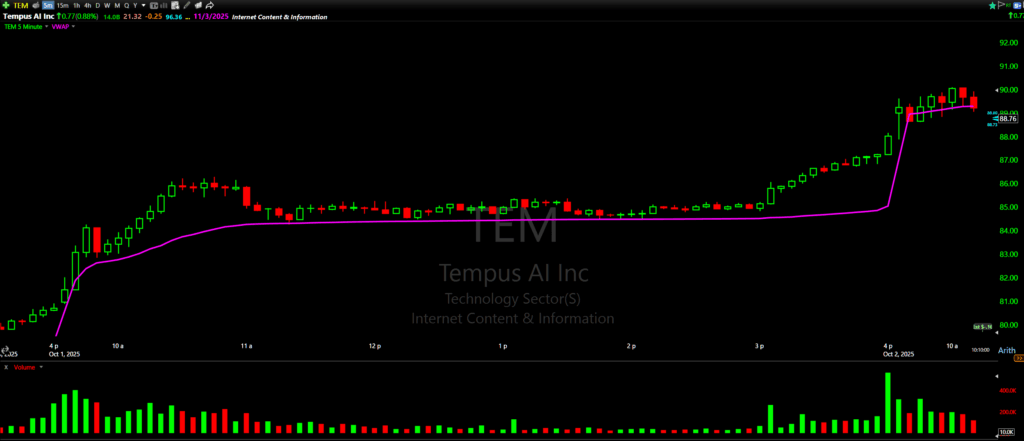
Just the price coiling, tighter and tighter…
Then, around 2 pm, TEM finally broke above VWAP with volume. Real buying came in. The move had conviction.
My calls hit all three targets by close for a clean 100% gain on the final exit.*
That’s the difference between trying to buy calls during a high-volume pullback vs. a low-volume pullback.
One almost always costs you money. The other quite often makes you money.*
What To Do When You See A Pullback
Next time a stock you’re watching drops, ask yourself:
What caused the pullback? News, scheduled event, or sympathy? Each one requires a different response.
What’s the volume doing? Heavy volume means be careful. Light volume means don’t overreact.
Is this invalidating my thesis? If the reason you entered the trade is still intact, the pullback shouldn’t cause you to exit.
Stop treating every tiny dip like a disaster.
Start reading the context. Use volume as your filter.
That moment where you previously would’ve panicked just might turn into the best trade of next week.*
Want to see exactly how I find (and execute) my trades?
The same system that delivered gains of 135%, 161%, and even 409% … just in September alone?*
Join Our LIVE OMEN WORKSHOP — TODAY @ 4:00 p.m. EST
Happy trading,
Ben Sturgill
*Past performance does not indicate future results