Good morning, traders…
If I told you one of the most widely tracked charts in the world has been on a perfect uptrend, gaining 44% year-to-date, what would you think?
Sounds bullish, right?
Well, I’m not talking about the S&P 500 or the Nasdaq…
I’m talking about the CBOE Volatility Index (VIX), which spiked above 20 yesterday.
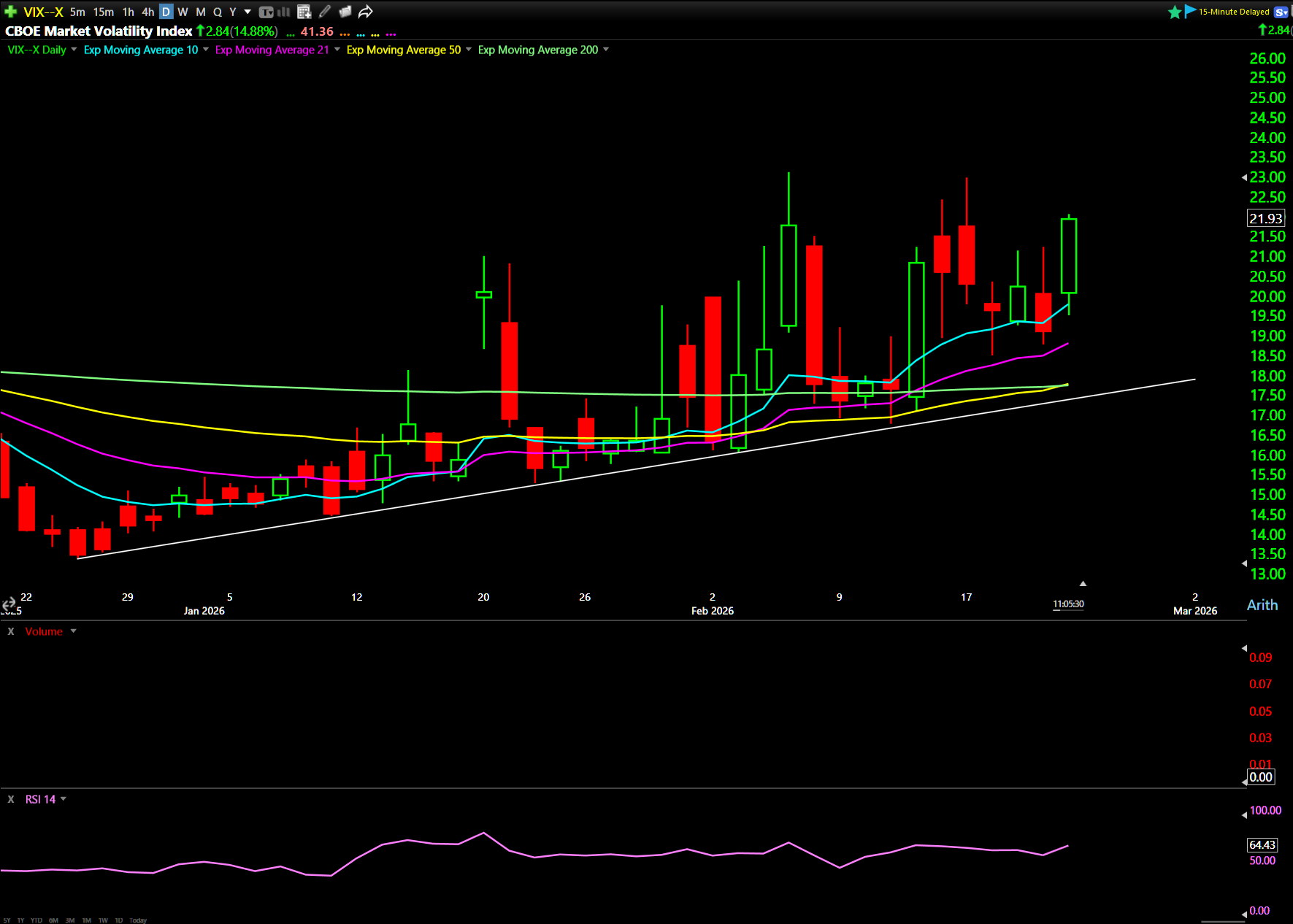
The VIX measures expected 30-day volatility in the stock market.
Most of the time, the VIX trades inversely to the S&P 500.
When the VIX is up, stocks are red (and vice versa).
That’s why it’s not exactly a bullish indicator to see an unstoppable, perfect uptrend in the VIX.
But it’s a crucial chart to use (and a major factor in how I trade).
With more than $1 trillion wiped out of tech stocks already in 2026, it’s now or never:
Adapt your trading to the current volatility…
How To Trade Different VIX Levels
Why do I watch the VIX? It helps me manage risk.
I’ll trade differently depending on the current VIX handle:
VIX 10-15: Markets move in predictable patterns. Trends develop slowly. Support and resistance levels hold. You can use normal position sizing and setup standards.
VIX 16-20: Reduce positions by 33% AND raise standards. Every box must be checked — Smart Money confirmation, volume, clean technicals. Begin hedging.
VIX 21-25: Cut positions in half AND become extremely selective. Only take setups where everything aligns perfectly. Increase hedges.
VIX above 25: Minimum viable positions AND highest standards. Only trade your absolute best setups.
WARNING: When the VIX crosses 20, you’ve gotta make two immediate adjustments:
- Your position sizing needs to shrink.
- Your trade selection needs to be ruthless.
This dual approach (smaller size AND higher standards) can be the difference between flourishing during a high-VIX period and watching your account blow up.
The Selectivity Rule
When the VIX crosses 20, I only trade setups with ALL of these elements:
- Smart Money confirmation: Institutional flow supporting the direction. No retail-driven momentum plays.
- Multiple timeframe alignment: Daily, 60-minute, and 15-minute charts all pointing the same direction.
- Clean technical levels: Clear support/resistance with multiple touches. No messy, ambiguous zones.
- Volume support: Above-average volume supporting the move. Thin volume means thin conviction.
- Risk/reward minimum 3:1: When win rates drop, your winners must be bigger than your losers.
I don’t care how “cheap” the options look or how “oversold” the charts appear…
If all boxes aren’t checked, pass.
The Right Position Size for a +20 VIX
When VIX spikes above 16, options premiums explode.
But you must size appropriately.
A High VIX creates opportunity AND danger simultaneously.
Manage risk first, capture gains second.
Smaller positions + higher standards = better results.
- Check the VIX every morning.
- Review open positions (and consider reducing exposure).
- Set alerts at 16, 20, and 25 for automatic notifications.
When VIX spikes, market conditions can shift overnight.
Your sizing (and setup selection) should shift with them.
Because while this high-VIX environment is generally bad for tech stocks, it could actually benefit one specific sector…
The 1 Sector That Doesn’t Care
Consumer trends shift. Retail collapses. Tech cycles in and out like the tide.
But the U.S. defense budget has increased in 62 of the last 65 years.
The customer is the federal government. The contracts run for years (sometimes decades).
And the switching costs are so high that once a company wins Pentagon business, it tends to keep it.
Now add this: The One Big Beautiful Bill just handed the U.S. defense sector its first trillion-dollar budget in history.
But that money hasn’t fully hit the market yet. The contracts haven’t been awarded. The winners haven’t been announced.
We’re at the very beginning of the biggest defense spending surge of our lifetimes.
And most traders will spend it holding the wrong stocks: the legacy contractors about to get squeezed out by a new generation of AI-first defense companies.
But not Tim Bohen…
Last year, he called:
- KTOS before it ran 179%.*
- AVAV before it ran 54%.*
- HEI before it ran 24%.*
How? He built an AI system specifically designed to find these stocks before the crowd arrives.
Now, he’s going to show YOU how to use it.
So you can trade this once-in-a-generation catalyst without being chained to a screen all day.
Click Here To Join Tim When He Goes LIVE.
See you there,
Ben Sturgill
*Past performance does not indicate future results