The most valuable stock in the market just followed my trade pattern.
And anyone who got the alert had a chance to play it.
These chances don’t disappear… join us for the next one.

Yesterday, July 29, I saw a very specific kind of price action forming in the market.
This is one of the 3 chart patterns that built my entire trading career.
Today you have the opportunity to memorize and master it…
My Trade on Apple Inc. (NYSE: AAPL)
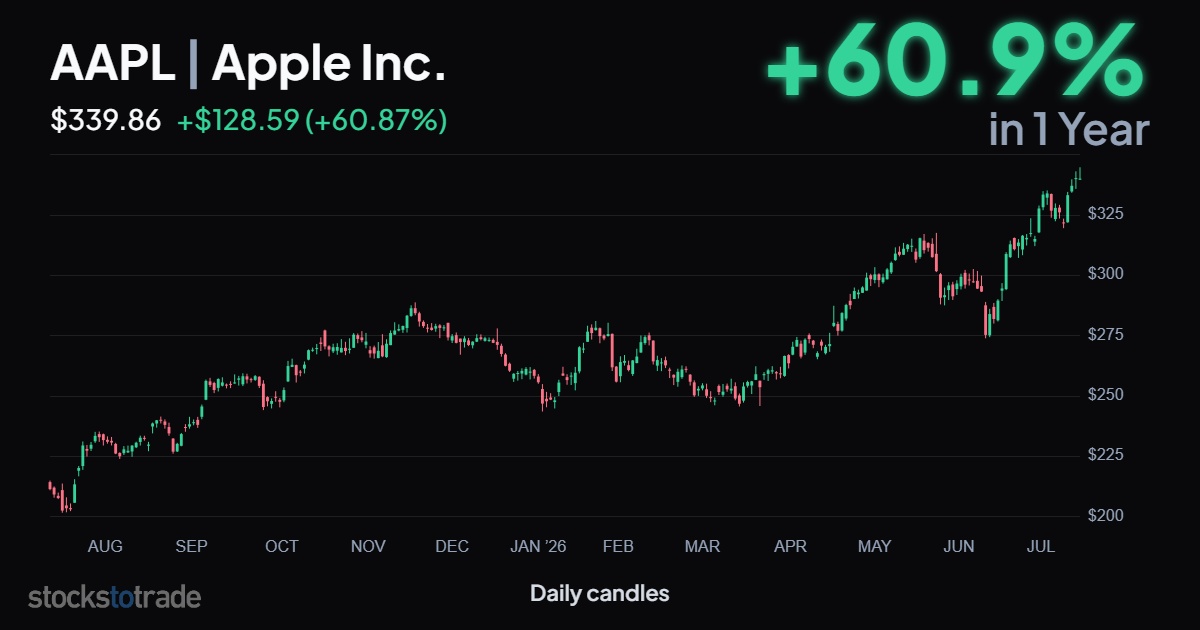
Apple Inc. climbed a staircase for twelve straight months.
The stock ran from near $211 last summer up to $339.86, a 60.87% gain, with the steepest leg arriving after March.
On Monday, July 27, Apple passed NVIDIA Corporation (NASDAQ: NVDA) and reclaimed the title of the world’s most valuable public company.
Tuesday morning, the stock spiked 1.8% to $342.89 and Apple’s market value crossed $5 trillion for the first time in history. Only one company had ever touched that mark before.
But the move didn’t hold. Shares faded through the session and closed at $340.08, with the market cap parked just under the legendary line in the sand, near $4.99 trillion.
Write that first number down. $342.89. It matters in a minute.
Why Apple instead of the AI darlings? Because the market spent this earnings season punishing capital spending.
Alphabet Inc. (NASDAQ: GOOGL) posted second-quarter revenue of $119.8 billion against the $116.93 billion Wall Street wanted, then shed more than 4% after management lifted 2026 capex plans to a range of $195 billion to $205 billion.
Tesla, Inc. (NASDAQ: TSLA) missed on profit, dragged down by the cost of its own AI push.
Apple runs the lightest AI budget of the top tech stocks… naturally, capital rotated toward it.
But the stakes climb again this afternoon. Apple reports fiscal third-quarter results after today’s close, with the call at 5 p.m. ET. It’s also Tim Cook’s last earnings report as CEO before John Ternus takes over on September 1.
Wall Street wants roughly $108.9 billion in revenue and $1.89 per share. The options market prices a move near 3.8% in either direction.
The “3x A Lady” Pattern
This is one of my all-time favorite patterns, named after one of my all-time favorite songs.
A stock will attack a level. It fails. It comes back and attacks the same level again. And it fails again.
The third time, it punches through.
Every failed attempt builds pressure. Shorts pile in and wait for another rejection.
But buyers refuse to back down. By the third run, enough momentum stacks up to overwhelm the sellers.
I call it a confidence pattern. The first two tries shake out the weak hands. Only the strong remain.
My Trade On AAPL’s Third Test
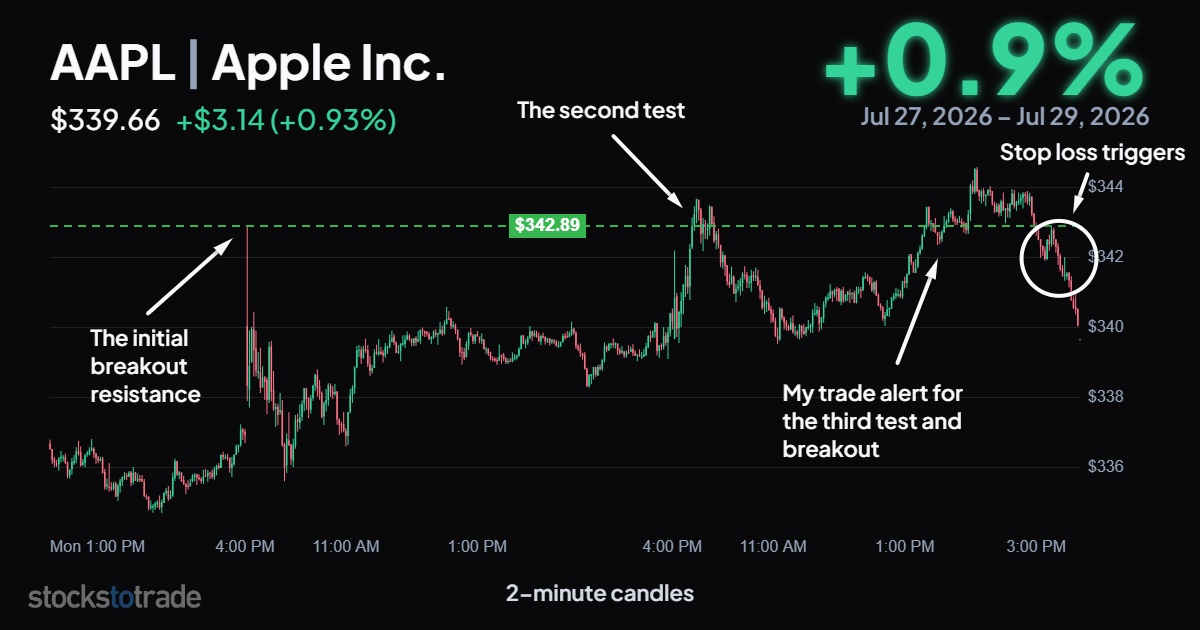
Tuesday morning brought the spike to $342.89, the print that tagged $5 trillion.
That was the first test. Rejected.
Tuesday afternoon delivered a second run to the same level. And it rejected again.
Wednesday afternoon, the third test set up, and my alert went out.
July 29 $342.50 Calls above $343. Target of $345 on the stock, with a 25% stop on the contract. My reasoning: a 3x a Lady breakout with MASSIVE call flow stacked behind it.
These were same-day contracts. That’s an all-gas trade with no room for error.

AAPL punched through the level and ran above $344, close enough to my target that anyone in the trade had room to scale out with gains on the table.
Then the chart rolled over and the stop triggered at a 25% loss.
A 25% Stop Is The Whole Point
A quarter of the premium sits well inside my risk on a trade like this.
Short-dated contracts can hand us triple-digit moves when a breakout extends, so a tight stop keeps the math tilted in our favor.
- It flags a loser early, before a scratch turns into a hole.
- And if you scaled out into the spike, you cushioned the position on the way up.
That’s the job. Take the win when the market offers it, cut the trade when the chart quits.
This pattern repeats. Mark your level, count the times the price tests the breakout, and let the chart confirm before you commit a dollar.
AAPL reports after the close today.
More volatility is coming.
Patient people take money from impatient people. Wait for these plays to come to you.
Be good (and be good to others),
Ben Sturgill
*Past performance does not indicate future results. Not typical.