Good morning, traders…
You’re watching a stock rip higher, and you know you should wait for a pullback.
But the momentum is building, FOMO kicks in, and you jump in anyway.
You can’t help yourself.
Minutes later, the stock reverses. Your position goes red.
Why does this happen? Because you don’t have a system for finding low-risk entries.
You’re chasing price action instead of waiting for specific moments on the chart where the odds are in your favor.
There’s one indicator that institutional traders use to identify exactly when to enter a trending stock.
It’s not complicated. It’s a simple line on your chart that shows you where Smart Money is defending their positions.
When stocks pull back to this line and hold, that’s your signal. When they break below it, that’s your exit.
This indicator is probably already on your charts, but you’re not using it correctly.
Today, that changes.
I’ll Show You Exactly Where To Enter A Pullback.
The Indicator
VWAP (Volume Weighted Average Price) is what it sounds like: a real-time calculation of a stock’s average price, weighted by volume.
Think of it as the market’s consensus on fair value price throughout the trading day.
When the share price is above VWAP, buyers control the action. When price is below VWAP, sellers dominate.
And when price pulls back to VWAP and holds? That’s where the magic happens.
How To Trade VWAP Pullbacks
This strategy has five steps:
Identify a strong stock. Look for clear upward momentum. Higher highs, higher lows, steady progression.
Watch for the pullback. Strong stocks don’t go straight up. They run, pause, and pull back to digest gains. VWAP is often where they find support.
Wait for confirmation. Don’t jump in the moment price touches VWAP. Watch for buying pressure to return: a big green candle, increasing volume, signs that the dip is getting bought.
Enter with defined risk. Take a position near VWAP with your stop just below the line. Your risk is clear from the start. If VWAP fails, you exit immediately.
Lock in your target. Aim for the prior high or the next resistance zone. Your reward should be at least twice your risk.
My VWAP Pullback Trade on PLTR
PLTR has been rallying, trending higher with momentum.
More importantly, it’s been getting hammered with call volume on my OMEN Scanner.
Palantir Technologies Inc. (NYSE: PLTR) gave me two possible entries yesterday:
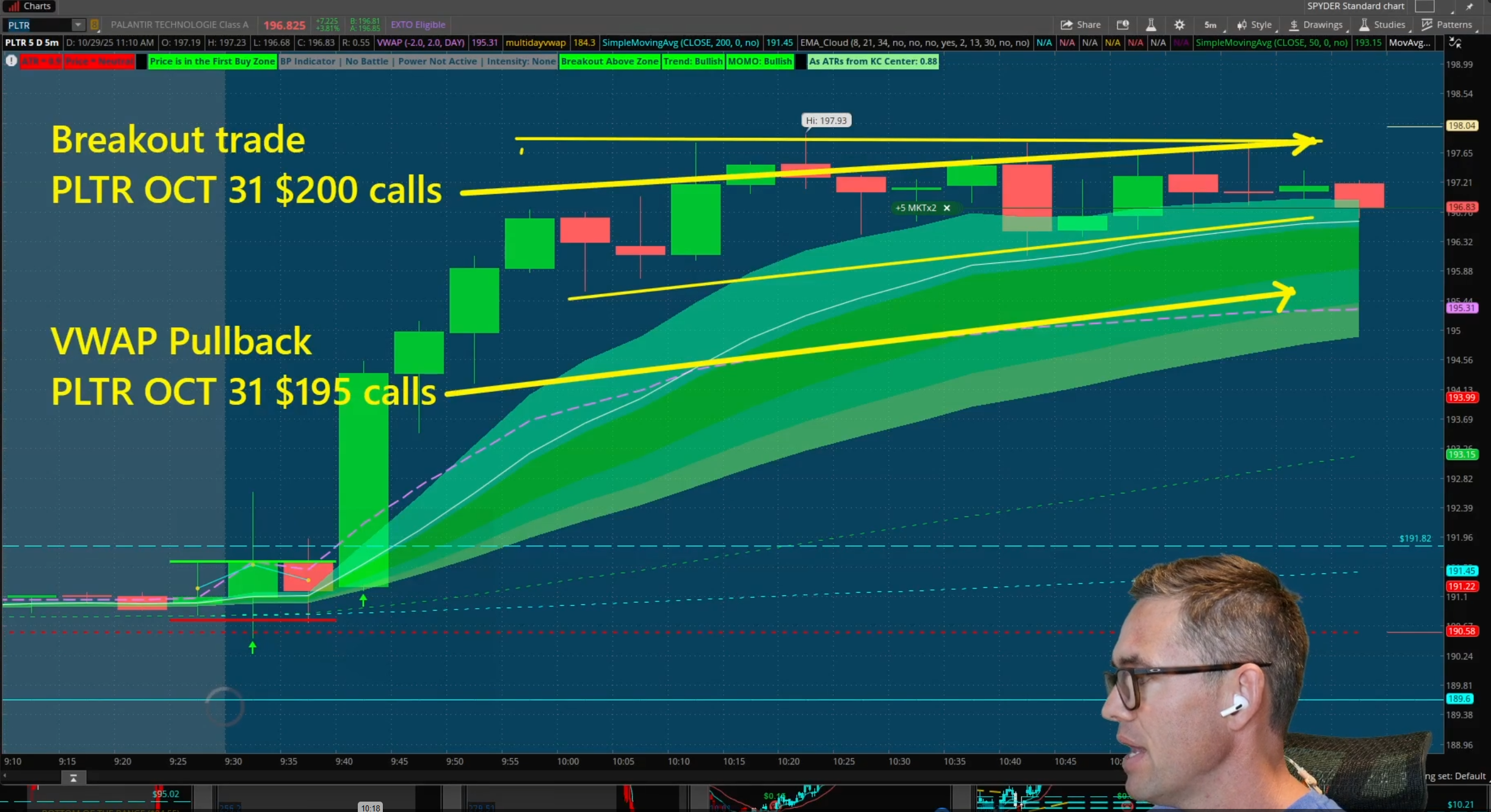
First scenario: If PLTR broke above $198, I’d buy the October 31 $200 Calls targeting $200 with a stop near $196.
Second scenario: If PLTR dipped to $195.50 (near VWAP), I’d buy the October 31 $195 Calls targeting $198 with a stop around $194.20.
I prepared both trades in advance using conditional orders. When the breakout happened, I executed.
Entry: $3.40 on the $200 Calls. First scale-out: $3.80. Next target: $4.10.
Trading around VWAP made this setup incredibly easy, and straightforward.
Want to see how I trade VWAP Pullbacks in action?
Join Us TODAY at 4:00 p.m. EST for a LIVE Smart Money WORKSHOP.
3 VWAP Pullback Mistakes to Avoid
Jumping in too soon. Price touching VWAP isn’t enough. You need confirmation that buyers are actually stepping in. Patience pays.
Ignoring your stop. If VWAP breaks, the setup failed. Don’t rationalize staying in. Exit and move on.
Oversizing positions. The favorable risk/reward means you don’t need huge size. Keep it controlled. Scale up only after the trade proves itself.
Why VWAP Pullbacks Work
I love trading VWAP Pullbacks for three reasons:
- Institutions defend VWAP when they’re accumulating. If you’re watching price action closely, you’ll notice how often stocks find support exactly at this level.
- This approach keeps you disciplined. You’re waiting for the stock to come back to a logical entry point where risk is minimal (and the potential rewards are huge).
- It gives you a roadmap. You know where to enter, where to exit if wrong, and where to take profits if right.
Put VWAP on your charts if it’s not there already. Start watching how share prices defend that line. And set conditional orders for the exact entry you want.
Happy trading,
Ben Sturgill
*Past performance does not indicate future results